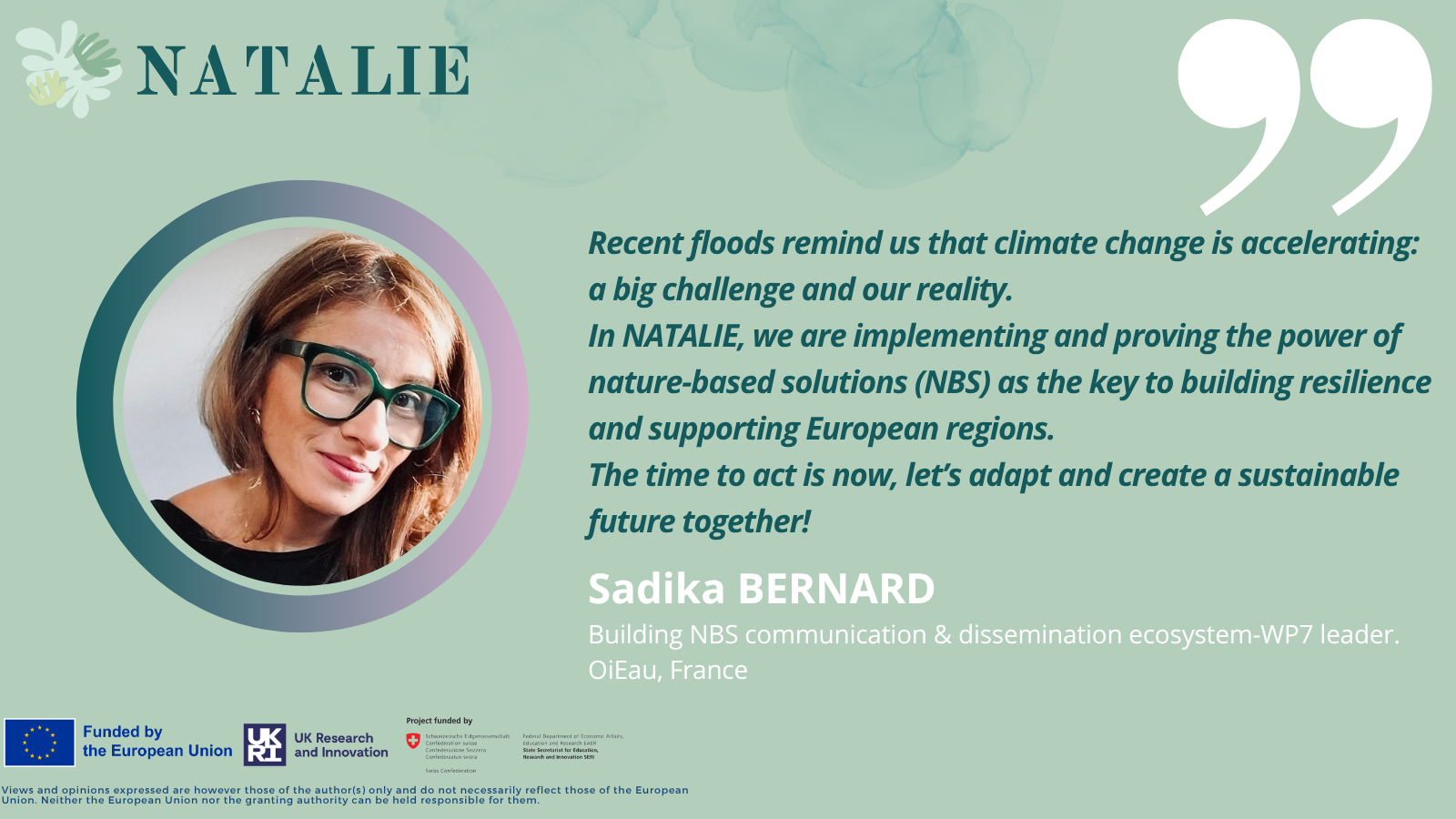
Climate change poses significant risks to European regions, including extreme events like floods and forest fires, as well as gradual changes such as sea level rise and droughts. These challenges require innovative solutions to build resilience and ensure sustainable development.

What is the EU Mission on Adaptation to Climate Change?
The Mission focuses on supporting EU regions, cities and local authorities in their efforts to build resilience and contributes to putting the EU’s adaptation strategy in practice by helping the regions to:
better understand the climate risks they are and will be confronted with in the future
develop their pathways to be better prepared and cope with the changing climate
test and deploy on the ground innovative solutions needed to build resilience
The Mission’s objective is to accompany by 2030 at least 150 European regions and communities towards climate resilience.

How NATALIE will contribute to the Mission on Adaptation ?
NATALIE, funded by Horizon Europe under the Adaptation to Climate Change Mission, plays a vital role in supporting European regions build resilience against climate risks. Through technological, financial and societal innovations, NATALIE implements 18 NBS across 6 bio-geographical regions, addressing climate risks like floods, droughts, and sea level rise. By 2030, NATALIE will help achieve the Mission’s goal of guiding at least 150 regions toward climate resilience.

How does NATALIE plan to implement nature-based solutions?
NATALIE combines technology, finance, and social engagement to implement NBS in 8 case studies. This ensures community acceptance, continuous monitoring, and evidence-based assessment of NBS performance, facilitating knowledge-sharing across Europe.
The key components of NATALIE's strategy
NATALIE's Booster Innovation Package includes technical, modeling, and IT solutions, as well as governance, policy, financing, and public engagement strategies. NATALIE will demonstrate 18 NBS in 8 case studies across 6 bio-geographical regions of Europe, with replication studies in 4 sites located in the same bio-geographical regions.