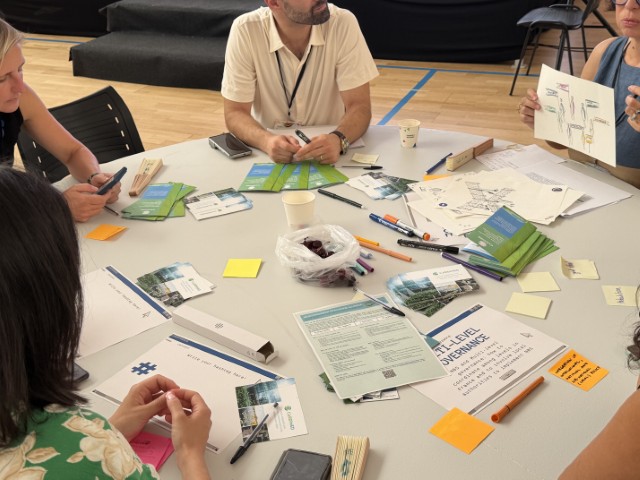
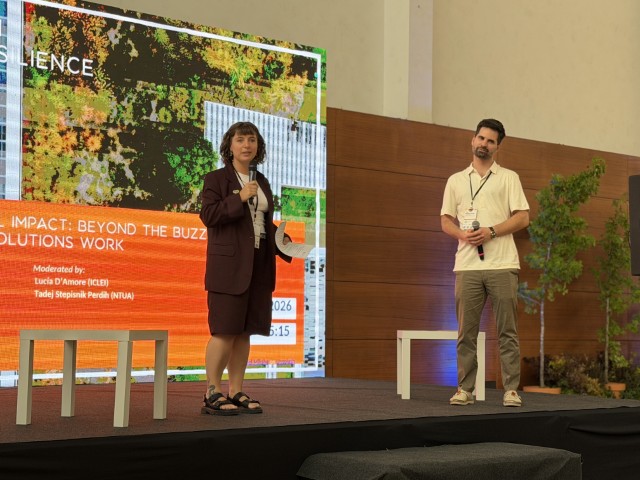
How can Nature-based Solutions move beyond inspiring pilot projects to become an integral part of climate adaptation across Europe's regions? This was the central question explored during the interactive workshop "Greener Regions, Real Impact: Beyond Buzzwords to Make Nature-based Solutions Work", held at the European Urban Resilience Forum (EURESFO) 2026 in Guimarães, Portugal.
The session brought together the NBS4EU Cluster projects CARDIMED, DesirMED, LAND4CLIMATE, MountResilience and NBRACER, alongside the Horizon Europe projects NURISH and Commit2Green, creating a unique opportunity for regional authorities, cities, researchers and practitioners to exchange practical experiences on implementing and scaling up Nature-based Solutions (NbS).
Facilitated by Lucia D'Amore (ICLEI Europe) and Tadej Stepišnik Perdih (NTUA), the workshop featured an interactive discussion format in which participants exchanged experiences, identified common barriers and explored practical solutions for accelerating climate adaptation through Nature-based Solutions.
The discussions were organised around seven thematic tables reflecting key challenges faced by European regions:
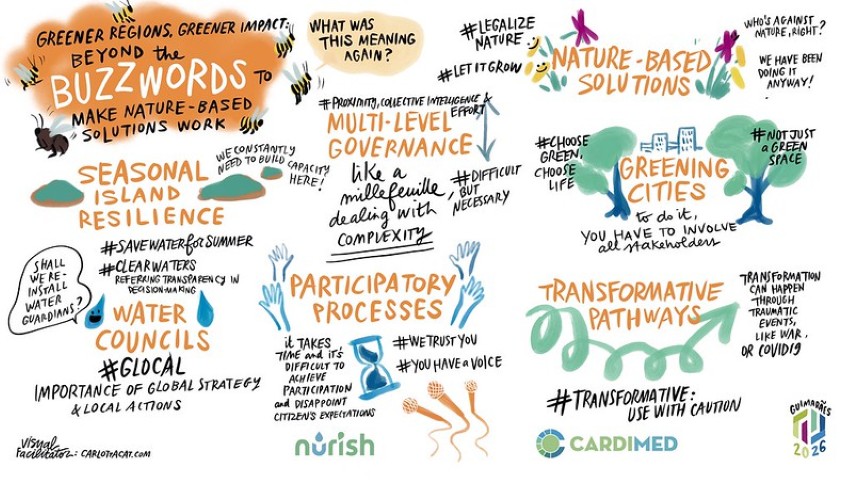
- Multi-level governance (CARDIMED): exploring how stronger coordination between regional and local authorities can accelerate the implementation of Nature-based Solutions.
- Wildfire resilience (DesirMED): sharing regional experiences on reducing wildfire risk through Nature-based Solutions.
- Water governance and financing (LAND4CLIMATE): highlighting water councils and innovative funding mechanisms to support climate adaptation.
- Citizen engagement (NBRACER): examining participatory approaches and the co-benefits of involving communities in Nature-based Solutions planning.
- Island resilience (NURISH): discussing seasonal water management and climate adaptation strategies for islands facing increasing pressure from tourism and climate change.
- Urban greening (Commit2Green): exploring how cities can safeguard and prioritise green spaces while balancing competing land-use demands.
- Regional resilience (MountResilience): presenting experiences from mountain and rural territories addressing climate adaptation challenges.
Together, these discussions generated valuable insights on governance, financing, spatial planning, stakeholder engagement and cross-sector collaboration, highlighting the importance of exchanging experiences between regions to accelerate the uptake of Nature-based Solutions across Europe.
The workshop also marked the public presentation of the Mediterranean Resilience Alliance, a voluntary network established through the CARDIMED project to foster long-term collaboration between regions, cities, municipalities and projects committed to climate resilience through Nature-based Solutions. Presented at the opening of the session, the Alliance aims to promote peer learning, knowledge exchange and the replication of successful Nature-based Solutions across the Mediterranean and neighbouring regions, extending collaboration well beyond the lifetime of individual projects.
By bringing together complementary expertise and practical experiences from across Europe, the participating projects demonstrated the added value of collaboration in turning innovative ideas into concrete action. The workshop reinforced a shared commitment to helping regions accelerate climate adaptation, strengthen governance and unlock the full potential of Nature-based Solutions for resilient communities.