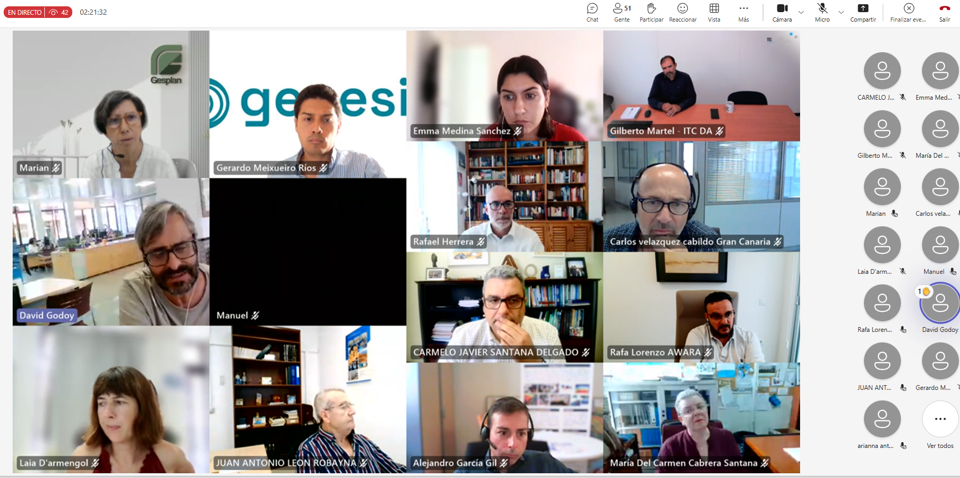
On July 30, 2026, the GENESIS Horizon project organised an online Networking Day focused on Nature-Based Solutions (NBS) in Gran Canaria, bringing together key stakeholders, researchers, and decision-makers to discuss water management challenges and innovative solutions.
The event featured presentations from La Palma Research Centre, the Geological and Mining Institute of Spain, the Island Water Council of Gran Canaria, the University of Las Palmas de Gran Canaria and the Canary Islands Technological Institute. A representative of Canaragua, partner of both GENESIS and NATALIE, participated to present the NATALIE case studies in the Canary Islands and explore opportunities for collaboration and synergies between the two projects.
Objectives and Topics Covered
The networking day aimed to raise awareness about NBS among local decision-makers and stakeholders involved in water resource management. The event addressed critical challenges facing Gran Canaria, including current water resource management issues, hydrological planning, and strategic objectives for sustainable water governance. Participants were introduced to the hydrogeological context of Gran Canaria's aquifers, the evolution of the coastal aquifer in Telde, and marine intrusion processes affecting the region.
A key highlight was the presentation of the GENESIS pilot implementation in Telde, showcasing an innovative approach to aquifer recharge and water security. The pilot utilises high-quality regenerated water from a nearby wastewater treatment plant, which is then subject to controlled infiltration into the aquifer. This NBS addresses multiple challenges simultaneously:
- It reduces pressure on overexploited aquifers,
- Demonstrates the viability of water reuse through natural infiltration processes,
- Helps combat marine intrusion in coastal areas.
The presentation covered the regulatory framework governing the use of regenerated water, the definition of control points for monitoring water quality, infiltration rates. Preliminary results demonstrate the effectiveness of this integrated approach to water resource management and ecosystem protection.
Synergies with NATALIE Project
The agenda included exploration of synergies with the NATALIE project, implementing three sub-cases:
- Flood-resilient park in La Laguna (Tenerife),
- Natural wastewater treatment improvements at Oasis Wild Park in Fuerteventura
- SUDS (Sustainable Urban Drainage System) in Maspalomas (Gran Canaria).
The most resource-intensive NATALIE initiative in the Canary Islands focuses on Maspalomas, Gran Canaria, where comprehensive scientific-technical analysis, social engagement activities, and investment analysis have been conducted. As part of the ongoing results of the Transformation Lab, the Canaragua representative explained the main co-creation actions: developing educational programs, promoting capacity-building at different levels (university, vocational training), and co-designing the pilot which, according to the representative, "could be described as a collective project." These initiatives demonstrate how integrated approaches combining scientific research and community engagement can develop innovative solutions to address water contamination and ecosystem protection.
Building a Community of Practice
As part of the co-creation actions emerging from the Transformation Lab in Maspalomas, the Canaragua representative presented the concept of establishing a platform or cluster for NBS in Gran Canaria. This initiative, born from the collaborative work and stakeholder engagement, aims to create a collective entity that promotes NBS across the region. The representative invited participants to join this emerging platform and contribute their expertise, resources, and perspectives to advance NBS implementation.
The event concluded with discussions on next steps and the potential for scaling and replicating these solutions. The collaboration between GENESIS and NATALIE projects demonstrates the European Union's commitment to supporting innovative, nature-based approaches to environmental challenges through the Horizon Europe Research and Innovation Programme.